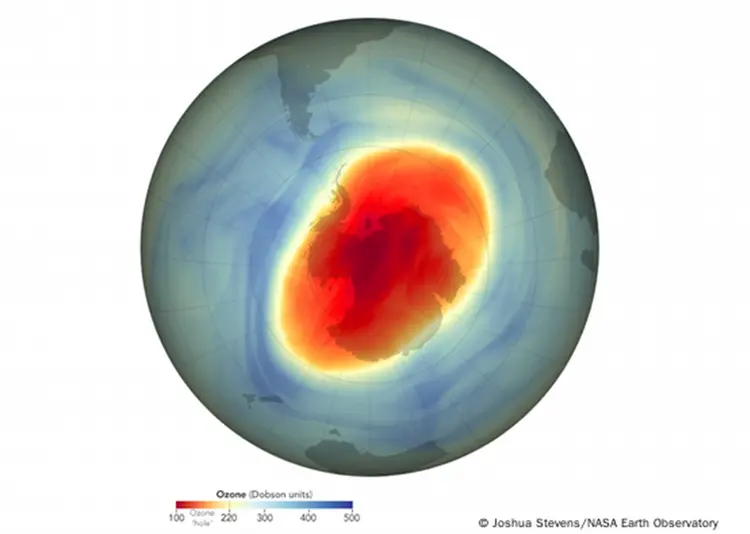
The ozone hole continued to shrink in 2024 and reached its smallest size recorded in recent years, the World Meteorological Organization (WMO) announced on Tuesday (09/16). According to the UN agency, the layer should recover by 2066.
- “The positive long-term trend reflects the success of coordinated international action,” the WMO highlighted.
In the 1980s, the ozone layer captured the public’s imagination, as scientists warned that its continued destruction could have catastrophic consequences for humanity and the planet.
These warnings drove the most successful environmental agreements in history, created to reverse this damage. But despite the progress achieved back then, holes still keep appearing in the ozonosphere, the layer that works as Earth’s sunscreen.
Located in the stratosphere, between 15 and 30 kilometers above the Earth’s surface, this layer is made up of ozone, a highly reactive gas. Although it is, on average, only three millimeters thick, it protects life on Earth by absorbing and scattering two types of UV radiation generated by the Sun.
- Without it, humans would suffer more cases of skin cancer, eye problems and weakened immune systems. Agricultural productivity would be harmed by damage to plant growth, and marine food chains would be disrupted.
In the 1980s, scientists discovered that chlorofluorocarbons (CFCs) – synthetic gases used in hairspray aerosols, refrigerators, air conditioners and insulating foams – were causing enormous damage to the ozone layer.
CFCs float up to the stratosphere, where exposure to UV radiation breaks them down into substances such as chlorine, which in turn splits ozone molecules apart. This process thins the ozone layer, which is often mistakenly described as the “ozone hole”. It occurs over Antarctica because of the low temperatures, which speed up this chemical process.
How the ozone layer was saved
Amid a multitude of environmental stories with sad endings, the ozone layer’s story offers a glimmer of optimism.
The Montreal Protocol, concluded in 1987, was a global agreement created to eliminate so-called ozone-depleting substances from the atmosphere. To date, 99% of these substances have been phased out, which, according to estimates, may have prevented two million cases of skin cancer.
- “Thanks to a global agreement, humanity avoided an enormous health catastrophe from ultraviolet radiation that would have poured through a gigantic hole in the ozone layer,” celebrated UN Secretary-General António Guterres in 2022.
This, however, does not mean the problem is in the past. The thinning of the ozone layer still appears every year over Antarctica, varying in shape and size due to changes in stratospheric temperature and circulation.
In recent years, the phenomenon has appeared at considerably large sizes. A hole that appeared in September 2023 was one of the largest ever recorded, reaching 26 million square kilometers – an area roughly three times the size of Brazil.
Although scientists cannot fully explain the phenomenon, they believe it may have been a consequence of the aerosol released by massive volcanic eruptions in the South Pacific in 2022 and of the cooling of the upper stratosphere caused by climate change.
What is known, however, is that these are anomalies within a general recovery trend. The ozone layer is expected to recover to its 1980 global average over the next two decades; by 2066 over Antarctica and by 2045 over the Arctic.
Ozone layer and climate change
Without the Montreal Protocol, the Earth’s additional warming could reach 2.5°C by the end of the century, according to a 2021 study published in the scientific journal Nature.
The efforts to save the ozone layer helped slow down climate change, since many ozone-depleting substances can cause the greenhouse effect. According to estimates, the Montreal Protocol prevented emissions equivalent to 135 billion tons of carbon dioxide in the atmosphere between 1990 and 2010.
- Without the protection of the ozone layer, forests, vegetation and soil would store 580 billion fewer tons of carbon.
The protocol was later strengthened by the 2016 Kigali Amendment, which enabled the phase-out of hydrofluorocarbons, which cause the greenhouse effect, in refrigerators and air conditioners.
The scale and speed of international action to save the ozone layer are seen by many as inspiring evidence of how the climate crisis can be tackled. However, a 2023 UN report warned that innovative technologies to combat climate change, such as geoengineering, could have negative impacts on the ozone layer.
One type of geoengineering known as stratospheric aerosol injection – which uses gases that reflect sunlight in the atmosphere to reduce global warming – could change the temperature, circulation and production of ozone in the stratosphere, contributing to higher rates of depletion.