The challenge: Anticipating extreme events in a vulnerable state.
Rio Grande do Sul frequently faces severe storms, hail, tornadoes and heavy rainfall. To protect lives, the Civil Defense needs to identify the risk accurately and act within minutes, not hours.
Without high-resolution real-time data, the window to alert the population and coordinate the response becomes dangerously short.
The solution: Technology, science and people in continuous operation.
Climatempo installed and operates a high-precision, solar-powered weather radar that feeds nowcasting systems with high spatial and temporal resolution. The operation combines:
- 24/7 monitoring of atmospheric and hydrological evolution.
- A multidisciplinary team of meteorologists, hydrologists and water engineers.
- Artificial intelligence and numerical modeling for accurate storm analysis.
- Direct technical support for public managers’ decision-making.
The radar has already proven its value in real events in Rio Grande do Sul:
- First Cell Broadcast alert in RS (October 2025): the radar identified a supercell with hail larger than 5 cm about 160 km away. Based on these signals, the Civil Defense sent a red alert directly to the phones of residents of Encruzilhada do Sul, Caçapava do Sul and Cachoeira do Sul.
- Flooding in Mostardas (May 2025): the radar estimated more than 150 mm of rain in just 6 hours, enabling early alerts and real-time monitoring by local authorities.
- Hail in northern RS (November 2025): the storm cell was identified and the Civil Defense alert went out 30 minutes before it arrived.
- Post-event investigation: technical notes prepared with radar data confirmed tornadoes such as the one in Camaquã, supporting the planning of future actions and the response to the affected population.
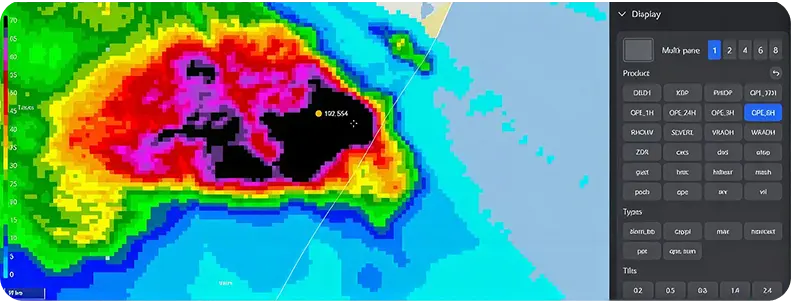
“The radar enables very short-term forecasting, with a resolution of up to 200 meters, which enhances the accuracy and efficiency of contingency actions,”
Cátia Valente, Head of Government Projects at Climatempo
A replicable model for protecting the population
The Porto Alegre radar shows that preventing disasters starts with accurate information at the right time. Recognized at an international conference, the project has become a benchmark in climate risk management and a model that can be replicated in other cities and states.
This is how Climatempo brings science and technology, in the form of data intelligence, to protect lives and support critical decisions.